


A couple years ago, I was backpacking on Labor Day weekend in the Dolly Sods Wilderness with my entire family — my wife, all six kids, my nephew, and my dad who I hadn’t been on trail with since I was in my twenties.
There is a campsite that exists on a now abandoned trail that no longer shows up on National Forest Service maps. My dad has been taking me there since I was a teenager. We’re not the only ones who know about it, but if you start to talk about it in community groups or message boards, the comments section immediately starts blowing up, telling you to keep your mouth shut about it.
But it was time I introduced my kids to it, to pass along the legacy. A place where you can be sure to have peace and quiet and one of the best swimming holes on Red Creek all to yourself.
I won’t have family land to pass down to my kids, but they’ll have that campsite.
The problem was I hadn’t been there in almost twenty years. The map my mind had filed away as the way looked absolutely nothing like the reality of the terrain.
There was no trail where I remembered it, and there were entire sections that I didn’t remember presenting themselves one after another.
So, after a long day hike, I found myself descending off the old logging road into a thicket of downed, decaying logs and rhododendron with my step-son and his girlfriend looking for familiar markers that didn’t exist.
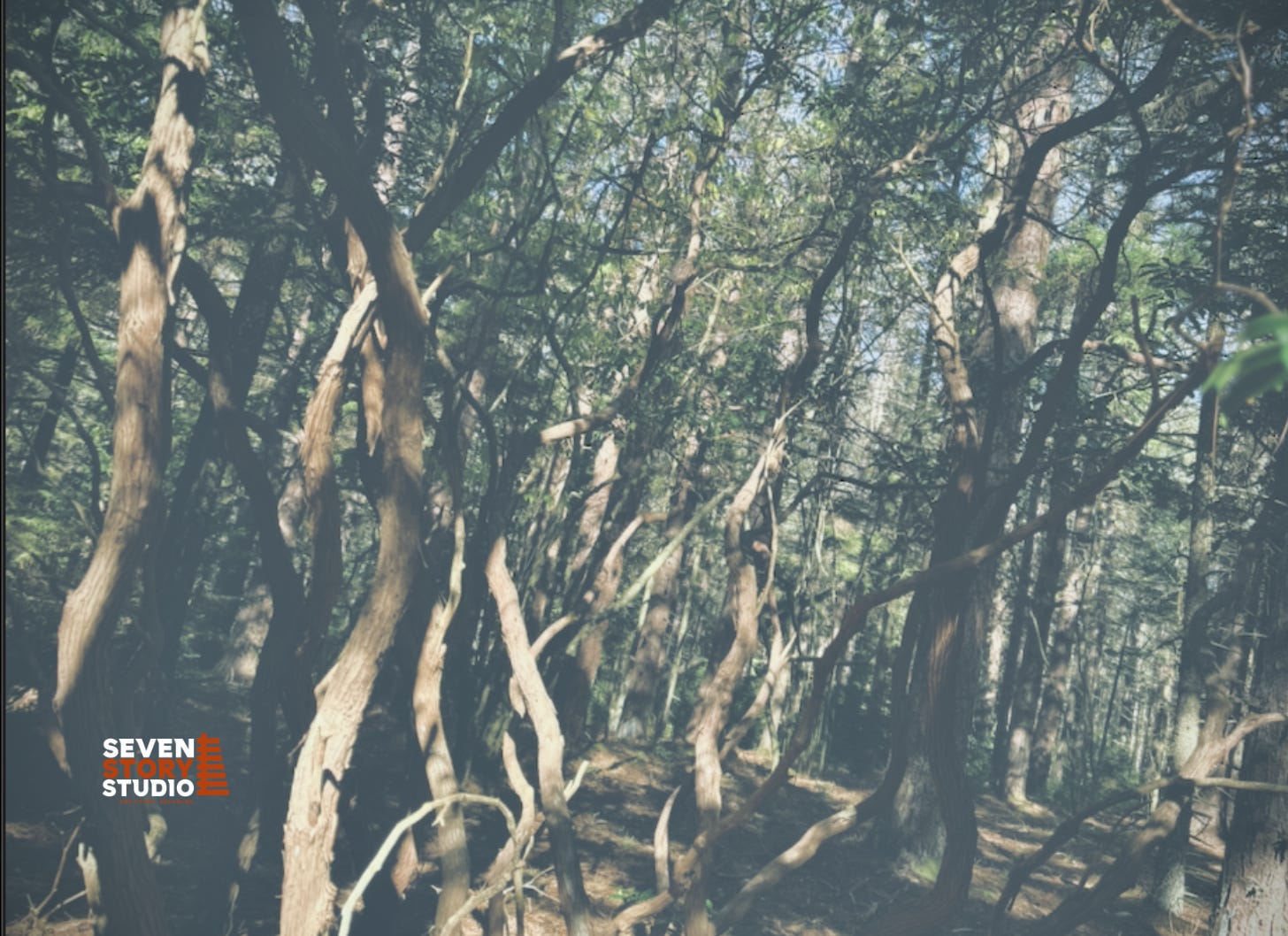
I led them down into what I thought was a path that ran along the creek. Surely, it would be there. It was not. And when I turned around to go back, the Rhododendron had closed in around me, their gnarled trunks, twisting and turning into a maze of knotted branches reaching up to grab the scarce sunlight available along the creek bed.
Each way looked the same. The only marker I had to orient myself was the creek that ran along my right side.
But I’d grown up feeling lost and in-between, so I did what I’d always done, I slowed down, told myself that I was home, and went to work figuring out how to use the land to my advantage.
THE PLACES WE’RE FORMED IN
I grew up in the Northern Panhandle of West Virginia. For the uninitiated, we’re the middle finger of Appalachia that sticks up between the states of Ohio and Pennsylvania. There’s a whole lot of symbolism there that I’ll let you work out for yourself. We’ve been working it out for years.
Historically, we’ve run on coal, steel, and pottery. We’ve used the Ohio River as our modality to move goods across the country. Problem is, the whole economy for those things dropped out in the 80s and 90s when it became cheaper to buy them overseas.
Our air got a whole lot cleaner, but nobody could afford to live here anymore because there was no economy, so it was kind of a wash.
We went from being an indispensable part of the industrial machine to an ugly scar the pointed back to what some considered to be a better time. And so, instead of making sure we were okay, America just kept rolling along without us.
Appalachia has a deep history of being one of the notoriously forgotten and inaccessible part of this country. We’re mysterious and old, if not a little misunderstood to outsiders. But we were something different up here on the Northern Plateau. When industry left, we were just kind of sad.
The North didn’t claim us because we were seen as just some dumb hill-jack rednecks. The Mid-Atlantic didn’t claim us because while there’s a power in these hills and hollers, it’s never been the type that plays well in politics. And the South didn’t want us because we weren’t seen as truly Appalachian because we still got sun that shone on us after 3pm.
And so, we just sort of died. Slowly. Alone. With no fanfare or thanks. Just the slow agonizing death of a place that was once something. Now nothing. Not even to the people who still lived there.
This was the place I was formed in. This was the place I was formed by.
THE MESSINESS OF MANAGING IN THE MARGINS
The most defining part of being formed in forgotten places is that you’re always managing from a place of want. Scarcity isn’t a season. Scarcity is a way of life.
Even your more well-to-do friends have less than those in places where people want to live — the kind of places people move to in order to escape where they are.
That isn’t to say there isn’t happiness or contentment in forgotten places.
In fact, some of the most content people I’ve ever known come from the margins. Having a little will teach you how little you actually need to find joy in this life. It might even help in that pursuit if we’re to believe Jesus’ teachings.
But even when you find joy in the simple, there are still paychecks to stretch, bills that get rotated month-to-month so that nothing gets turned off when the money runs out before the demands from creditors. I remember a good friend of mine’s mom once told me that the water bill wasn’t due until she got the red envelope.
It’s only been the last few years that her little piece of working-poor wisdom wasn’t necessary in my own life from time-to-time.
Some of you may read that and quietly judge. To that, I say, “Good for you.”
I’m sincerely happy that you’ve not had to know the type of anxiety and pressure that comes from working forty-plus hours a week, or perhaps working two or three jobs at a time, and still not being able to make the ends meet of a rope that is far more tattered than anything you dreamed of as a child.
When you grow up in a forgotten place, you know that the things you see in magazines, television, or on social media aren’t really achievable without escaping, doing something illegal, or getting extraordinarily lucky.
You realize early that those things are not for you. They exist in places that might as well be fairy tales.
By the time you’re in high school, you’ve already turned around and realized the rhododendron has closed in around you.
So, you have two choices.
You can stop moving and set up camp, or you can start moving in a direction and hope its the right one — no compass, no sun breaking through most of the time. Just a gut feeling, some colloquial wisdom from others also stuck in the tangled maze of the margins — our life a living laurel hells.
THE CALL TO MOVE BEYOND THE CROOKED
Every person I’ve ever met from Appalachia who showed any promise — defined locally as having a chance of rising above the ever-present mist that hangs over the hills and hollows — has been taught that in order to be taken serious, you must first learn to not look or sound like where you’re from.
And so, we’re reprimanded early on for our bad grammar or “lazy” ways of talking. We spend much of our formative years trying desperately not to look or sound like the family and friends who raised us.
It’s an odd feeling to grow up in a place that teaches you not to be from that place. There’s a profound disconnect that happens when you’re taught to internally and externally reject the culture and people you should feel most profoundly linked to.
What do you do when the place you’re from teaches you that you’re “less than” for being from that place?
By the time I was in college, all I wanted was to be “not from here”. And as I branched out and formed relationships with different people from different parts of the country and world, I wondered at the pride they felt when they spoke of their home.
I was from West Virginia, and you’d be hard pressed to find a population that has more state-specific tattoos and pride, but when anyone I knew was asked where they were from, we would all answer by saying how far we were from Pittsburgh or some other major city.
And so, I learned to change the way I spoke, the way I wrote, the way I carried myself in the world. I learned to relax only when I was around family or particularly close friends who were also from similar beginnings.
But eventually, I stopped ever falling back into my embodied genesis. And, honestly, I was praised for it.
I was listened to more in both classroom and board room.
I was asked to speak at pulpits and large presentations.
And all the time, I had a growing sense that my voice was not my own. There was no connection to it.
Interestingly, I found I was very good at writing for others. At first, I thought this was some sort of professional talent, but what I think actually happened was that I exercised a very specific muscle — how to sound, think, and become someone I wasn’t.
WHEN THE MAN EMERGES FROM THE THICKET
In 2022, I logged into Twitter/X and began posting like I’d done more than a dozen times — speaking into the unlistening void of a platform that doesn’t know you exist yet. But instead of just posting, I decided to join the conversation that was already happening in spaces considering what it meant to reimagine the church in a post-Christian America, particularly in those deconstructing evangelicalism and engaging scripture from a more contextually nuanced and prophetic interpretive lens.
And for whatever reason, this time my voice found people who cared what I had to say. And what’s more, they seemed to appreciate my voice the most when the learned filters faded into the background.
My Appalachian background wasn’t a hindrance or obstacle to overcome. It was precisely the reason my voice was attractive and worth listening to.
To a room full of marginalized voices, polish and privilege has nothing to offer the conversation.
Even though most of us left Twitter/X after the 2024 elections, that community remains one of my core networks. I’ve been invited to join conversations at post-evangelical conferences, to join design teams with groups like The Wild Fig Network, and I’ve been humbled to be been invited into the ongoing work of the Parish Collective, hyper-local networks rethinking what it means to be the church in neighborhood settings instead of suburban campus destinations. It even led me to deeper study of scripture and contextual leadership with Pillar Seminary.
And in each setting, it is my experience in forgotten Appalachian and rust belt communities that provides the rooted grounding for anything important that I have to say or contribute.
My lived experience in the crooked, messy, and slightly dangerous communities that empire forgot are not things to hide and mask behind a more polished public presentation.
Those are exactly the things needed to move the church’s prophetic mission back into our communities.
Turns out, we were not left behind and obsolete. We were the prophetic warning of what was coming for the world at large.
WHAT IS “THE LAUREL HELLS”?
For most of my life, I’ve felt caught between two bad options.
We had to stay still in what we called “milltown mediocrity” or abandon my home and be unattached from my place.
That’s the dual danger of the laurel hells.
You can be frozen in place for fear of losing whatever familiarity you have by going deeper, or you can run headlong into the brambles and forget the context of where you came from in the hopes of arriving absolutely anywhere that doesn’t seem so suffocating.
How do you balance those two reactions into something useful to your own survival while still being true to your mission to find your way back to yourself?
The answer is to root your journey into what is known as you venture into the unknown future. Not trapped in place. Not pushing into terrain wildly without the care and respect the journey demands.
The answer is the creek to your right. The sun that peaks through the tree. The direction the water runs. A knowledge of how to read the land and where it is you’re trying to end up.
When I stood among the confused landscape, I knew a few things: one, the creek was on our right side, and our camp was along that same creek further north (so I had to keep that on my right side); two, I knew the approximate distance from the creek that the campsite was and how close to the creek we were; and three, I knew that somewhere along the way, a trail would open up that followed the creek past a tree with old items found among the old logging camps that littered the creek.
With those things in mind, I went backwards, moved a hundred yards or so west away from the creek while keeping it in sight. I followed the more open areas (because there had once been a trail and rhododendron take years to grow large enough to trap you) until I saw my dad come up over a rise, signaling that I was home and on the right path back to our camp.
You follow what you know in order to unlock what you do not.
You move among what the brambles give you because you know, deep down, the way they grow is in search of light. And where there is light, there is life.
The day ended with the kids losing themselves in laughter as they lept from the banks into Red Creek as we adults sat around the fire sharing stories and dreaming of the their future.
And that was enough.
Because they know where this place was now.
And how to find it again if they ever lose their way.
And they’d never hear from me that they needed to be anything else than what they were.
Place. Passion. Person.