


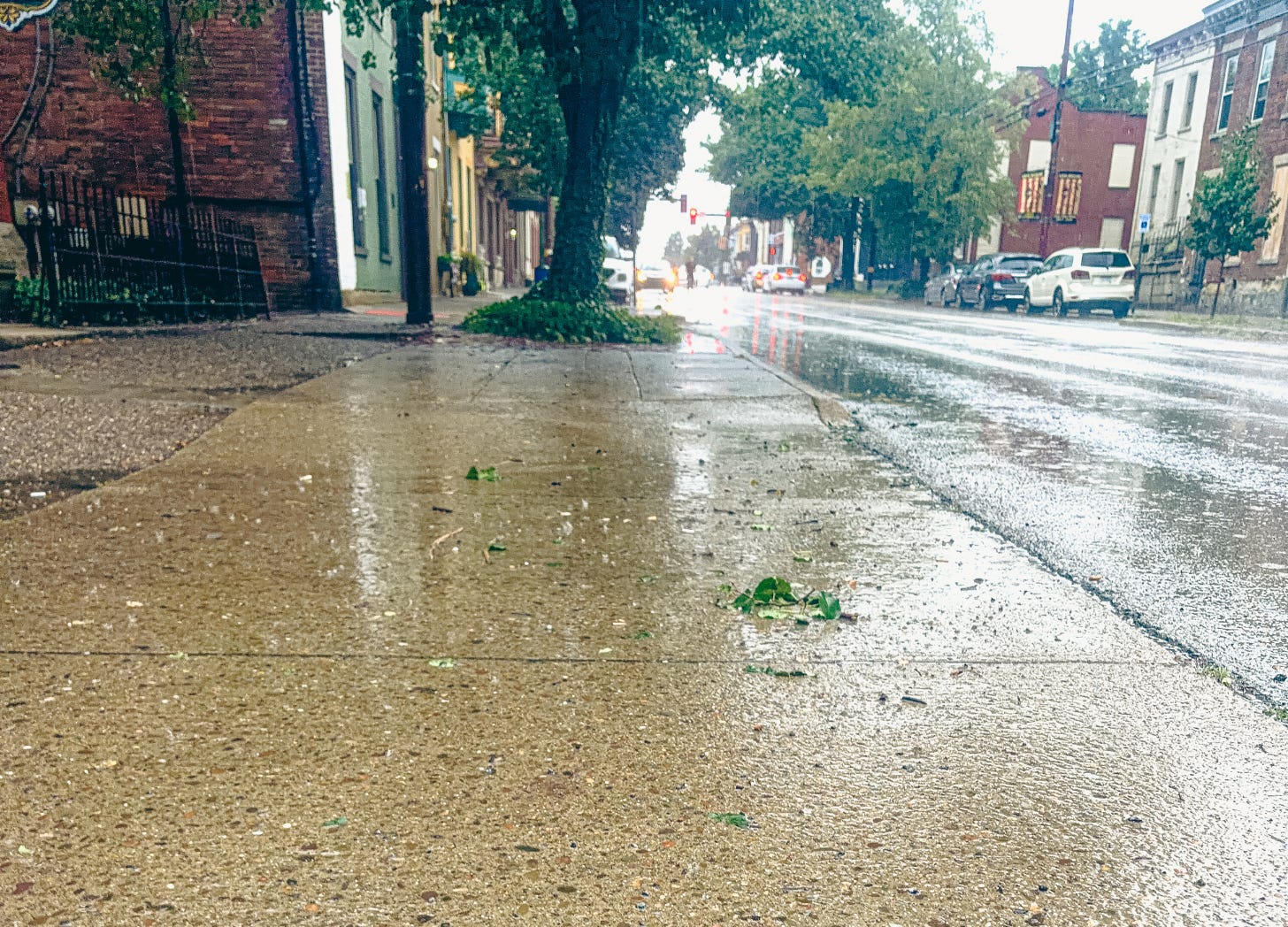
The other night, I walked out onto the sidewalk from my front stoop and felt the same eerie calm I sometimes feel in the deep woods of the wilderness.
It was 7pm, the sun had moved over the peak of my house leaving more shadows, and the traffic on our normally busy street had died down to a trickle of cars turning left at the intersection and then slowly building speed past our home on their way downtown.
There were no kids playing.
There was not a single person on the sidewalk.
There were no adults sitting with a cold beverage after a long day at work.
The only sounds that could be heard were the accelerating sounds of someone trying to get somewhere else and the steady hum of an army of air conditioners keeping each of the homes and apartment buildings around me artificially cool against the thick Appalachian humidity.
My street was a relational desert.
My only thought, “My God, what have we done?”
The Context of My Neighborhood in North Wheeling
I live in a neighborhood called North Wheeling, the oldest neighborhood in Wheeling, West Virginia, in what is called Victorian Old Town, the oldest section of that oldest neighborhood. Our section of row houses date back twenty or thirty years before West Virginia was even a state, the earliest deed on my house is 1863, but it is almost certainly older.
As you can imagine, in the early days of the city, my neighborhood also become a main artery into the commercial district known across the ever-expanding nation as the “Gateway to the West” — the official launching point for most of the caravans heading west to escape their reputations or make the fortunes necessary to create one at all.
That road to the west was called National Road, and the street that runs north and south to meet that National Road became Main Street and remains a busy street to this day. It was along that Main Street that I found myself on this particular evening.
This is the street where we live and have raised a family.
And the coldness of that moment bristled against the warmth of my own childhood. We spent many evenings at my grandparents house, and everyone knew that if you showed up to my grandparents and walked around to their back porch from spring until fall, you’d find them there sitting as the sun went down. And what’s more, you’d find their neighbors on their porches. Even as a child, we knew all those neighbor’s names and the unique rules for each of their yards, including which were open to our shared games of tag, relievio, whiffle ball, or some other made up nonsense that ended each day before we got ready for bed.
And those neighbors watched us grow. They bought us popsicles. They attended our birthday parties. And they absolutely called our family when we were doing something we shouldn’t have been.
There were your house rules, but there were also unspoken neighborhood rules, and those rules were just as sacred, passed down from one generation of kids to the next in whispered lessons when one of those rules were unknowingly broken.
The neighborhood became an extended family that watched out for each other instead of competing against each other. It was a relational ecosystem that provided boundaries and safety to learn and grow.
But now, in comparison to those memories, the neighborhood I found myself rooted to and in love with felt empty. I looked up and down the street, and I realized that while I might be able to name a few of my neighbors, I couldn’t tell you their stories, and I certainly wouldn’t have felt comfortable letting my children play in their yards.
So, what happened? And how do we reclaim what’s been lost?
Devil, Thy Name Is Air Conditioning
Listen, don’t get me wrong, I love my air conditioning probably more than the next guy.
As someone who starts sweating if he even looks at the sun, I am known for regularly exclaiming out loud, “God, it just never gets old,” when I come through the front door and I’m greeted by a fifteen degree drop in temperature on a particularly humid and offensively hot day.
But the devils in our lives often hide in the shadows of our comforts.
And, my goodness, is there anything more addictively comfortable than central air conditioning?
Now, I’m not saying that having central air is sinful. I’m not advocating that we all suffer summers of sweat and heat stroke for the sake of neighboring, but I am saying we should be aware of its hidden effects on the way our communities have become more fractured and fragile.
St. Anthony, the first desert father of Orthodox Christianity, taught that after the cross, the deceiver had no real power in this world after Christus Victor. Instead, he can only manipulate us into following the desires of our own ambitions already present.
I think our desire for comfort and unbridled freedom is one of those core desires — to forego any responsibility for our neighbors by purposefully cultivating a life and environment that encourages withdrawal, anonymity and individual ambition.
The fact is that it is much easier, safer, and simple if we live lives that make interruption more difficult and keep our accountability to others at a minimum.
It is much easier in our day-to-day to “not belong” to anyone or any place.
Unfortunately, recent studies have suggest that this is exactly the root of why so many people are now facing feelings of increased loneliness, depression, displacement, and a general sense of disembodied living.
We were meant to belong to a conversation bigger than ourselves and the practice and evidence of our faith was meant to be so much bigger than a personal relationship with God, language that would have have been wholly foreign to the early church communities or their surrounding cultural context.
Is this all to be blamed on central air conditioning? No. Of course not.
But it’s the lotus flower that makes our escape from the calypso of comfort into the heat and brokenness beyond our front doors and into our neighborhoods all the more difficult to achieve.
I mean, who among us wants the discomfort of being more involved in the messiness of community and responsibilities we share to the places we’re from? That’s certainly bound to cut into our time spent doom scrolling or binge watching our favorite shows.
And even as I ask that question, I hear the hum of my own air conditioner calling me back inside to the safety of what I’ve built and can control with the touch of a thermostat. I am not beyond that pull. Christ have mercy.
The Christ Moved In So That We Can Move Out
My favorite sections of scripture are the first eleven chapters of Genesis, the sermon on the mount, and the first chapter of the gospel of John. You wouldn’t have to twist my arm very hard to get me to preach, teach, and live from those sections for the rest of my life.
So, let me hit you with a core verse from those sections, John 1:14.
“And the Word became flesh and lived among us, and we have seen his glory, the glory as of a father’s only son, full of grace and truth.” (NRSVue)
I almost always use the New Revised Standard Version updated edition, but in this case, I really like Eugene Peterson’s translation a little better. I think it really captures the colloquial nature of what I think John would have talked like.
“The Word became flesh and blood, and moved into the neighborhood. We saw the glory with our own eyes, the one-of-a-kind glory, like Father, like Son, generous inside and out, true from start to finish.” (The Message)
This translation pivots on the greek word eskēnōsen which means “pitched his tent” or “tabernacled” — the idea that the Creator showed up in the form of a human being in the middle of a specific time, place, and context to truly live in relationship with his creation … with us.
God didn’t just give a new set of laws. He didn’t even give a better explanation of the laws he’d already given (which would have been more in line with his heart, I believe). Instead, he showed up to model the lives we were supposed to be living all along, as well as how to model how we are to live with each other and the rest of creation.
He didn’t stay outside of the neighborhood. He didn’t stay in the safety of a sacred building inside the neighborhood. He chose to close the gap and live among the messiest parts of creation as an embodied part of it — for better and for worse.
The Porch & Stoop as Urban Thin Places
Recently, I was talking to a good friend of mine about church trends, and my ever-increasing belief that one of the major problems over the past fifty years is that we abandoned urban centers and the idea of smaller neighborhood churches for sprawling suburban church campuses that people drive to as a destination experience.
Think about that for a moment.
We are called to take the good news of the reconciliation of all things back to the Creator into our neighborhoods and instead we inadvertently spread a message that the only viable spiritual solution is to escape this world for the promise of a better life after we die.
Christ preached victory. We preach escape.
In the course of this conversation over more than one cup of coffee, we began to talk about what that means in neighborhoods where the neighborhood church is dead or dying, and I proposed the solution that’s always worked for me.
The porch as thin place.
In the ancient stream of the Celtic church’s teaching and practice, thin places were often found in the semi-wild spaces of the world. The forgotten places. The places where one thing ended and another began. They were the places where the veil between this world and the next, between the physical and the spiritual planes became so thin that they bled into one another, becoming a bridge between he two.
For me, that has always been what porches represented in the neighborhood. Porches aren’t just the liminal space between outside and inside. They’re the place where the community and the individual household meet. They’re the place where strangers become acquaintances, acquaintances become friends, and friends become family.
Porches are a place of conversation and conversion, hot topics and cool drinks, slow evening cocktails and early morning coffee where you greet your neighbors as they jog past or walk their dogs.
And it’s in that thin place of slow ritual and relationship, that the kingdom of God has always flourished most completely.
And, in my own experiences, they are the places where I’ve seen the Creator’s spirit do the most profound work of healing and transformation.
What Actually Happens When We Tackle the Weeds that Have Grown Up Around Us
A week or so ago, our neighbor asked if our youngest daughter would be interested in doing some work for her. It’s a hard hustle for a fourteen year old girl who wants to work but is too young to get hired anywhere, so she accepted without hesitation.
As it turns out, our neighbor wanted to pay her to pull all the weeds on both sides of the sidewalks on our neighborhood block.
Claire departed late in the afternoon and didn’t return until almost nine o’clock when the sun was going down.
I expected her to come in tired and dirty with a bit of an attitude after being on the hot sidewalk bent over picking weeds for the better part of a half a day. Instead, she came in with an energy we hadn’t seen from her in quite awhile. Certainly not the kind of energy she finds bed rotting in her room as she calls it.
She talked about all the dogs she met, about the conversation she had with the man we’re regularly annoyed with for taking up two spaces in our limited on-street parking — that he was “actually kind of nice.” She told us that one of our neighbors had been taken to the hospital in an ambulance, that we had a couple young families further down the block with young kids and they were “really cool.” She talked about people and conversations and more than a little of the “neighborhood tea”.
What she didn’t talk about was the work itself. She never mentioned the ache in her back or heat of the day. She didn’t talk about itching or how miserable it was … or even that people should take care of the patch in front of their own houses so the work wouldn’t exist at all.
The work was framed for her within the context of the people that shared this short block we live on. The work mattered because, maybe, just maybe, she began to realize that we all belong to each other because we all share this space, this gateway to the city that is a gateway to the west, that is older than our state.
In that moment, she too became the hands of the creator made flesh and truly dwelt in the neighborhood. And just for a moment, there were far fewer weeds.
And it struck me standing on the sidewalk, that even without front porches, that there would be far less weeds to pull, if we just decided to take care of the sidewalks and our neighborhood block together.
And in that work together to restore what has been forgotten, Jesus becomes flesh again. And after we worked together, to escape to someone’s back porch, or maybe around a small fire pit to share our stories, our dreams, and even the places in our lives that need restored.